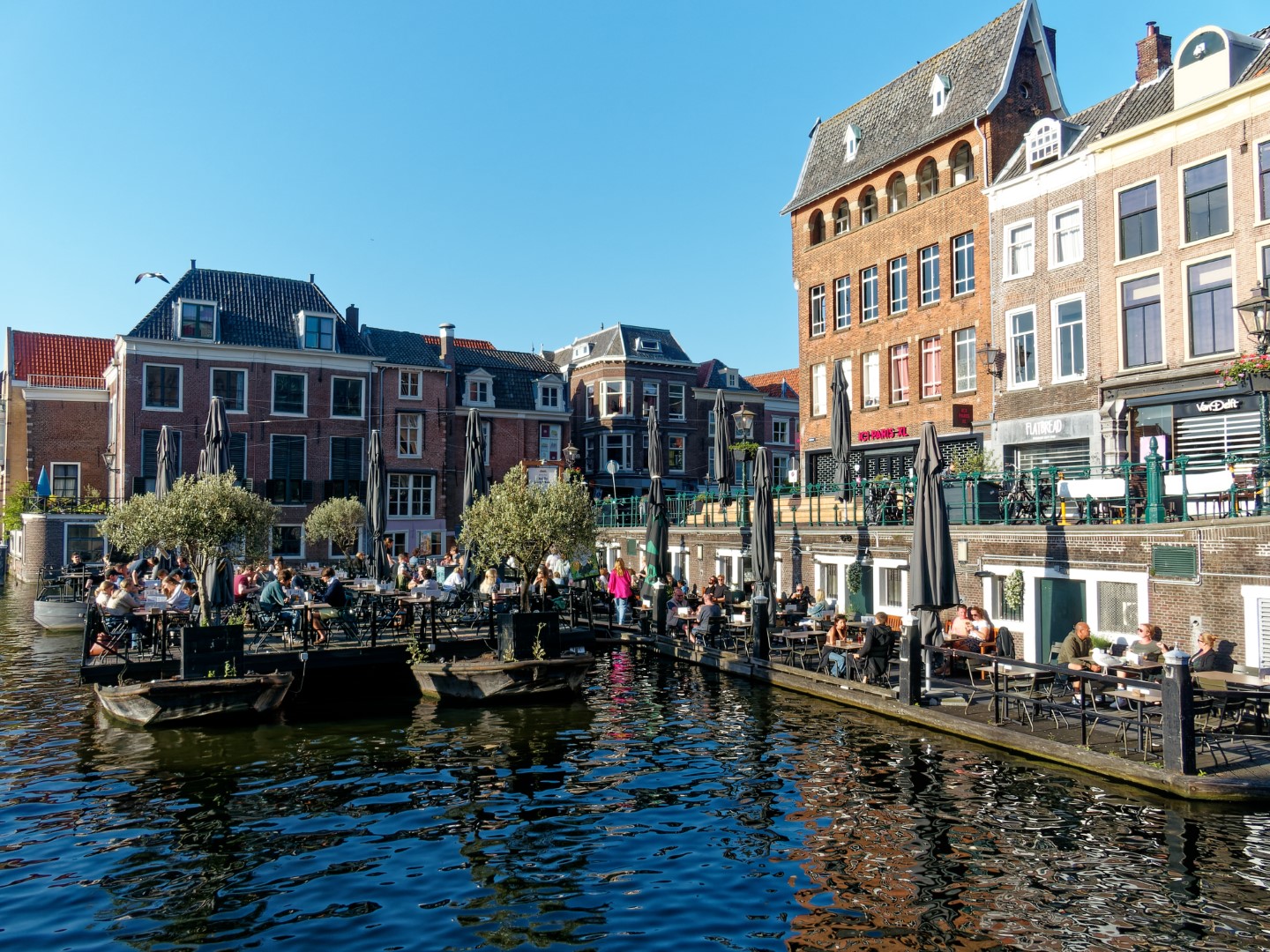
From my notes in no particular order, regarding our trip to the Netherlands.
This was our first real international trip – something we should have done long ago. We spent two weeks in the Netherlands, mostly in Utrecht and Leiden areas, but also visited Castle de Haar, Gouda and Zaanse Schans, outside Amsterdam. Spent the last few days in Amsterdam.
Netherlands is a beautiful country with wonderful people. We expect to return there again in the future. Would probably base a future trip out of Utrecht (we really liked both Utrecht and Leiden) – Utrecht is centrally located and train access and services to nearly everywhere is great and convenient.
Travel Light
We each took a standard sized carry-on wheeled luggage pack, plus a day pack. I considered taking a backpack that meets the luggage carry on standard but decided it would be easier to not carry the backpack for some long walks between places or while potentially standing in long airport security lines. Since I blew out my knee during the 2nd week, this turned out to have been a good decision! Any extra weight made the knee worse! A roller bag was much easier to handle.
Restaurants and Food
Portions sizes are smaller than the oversize portions generally served in the U.S. I am thinking of Mexican and Chinese restaurants in the U.S. which often provide twice the amount of food that would be reasonable for a meal.
A “medium” cafe latte is typically about 8 ounces (220 ml), not the 12 ounces (330 ml) in the U.S. In fact, 12 ounces is typically the largest coffee drink I saw – where as the U.S. has gigantic “Grandes”.
Same goes for soft drinks – typically 220 ml (8 oz) although 330 ml (12 oz) are sometimes available. Soft drinks taste less sweet than in the U.S. – probably because they contain less sugar or HFCS. I’ve heard this is true for packaged breakfast cereals too.
The food at venue cafes – such as museums – was very good. Not the usual “burgers and fries” we see at many U.S. venues (I am told I must go to the wrong venues – that there are good cafes in U.S. museums too!)
Stores
In retrospect, I wish I spent more time visiting stores. The only stores we went into were some grocery stores and a couple of pharmacies. These are interesting as they show what kinds of foods are popular and how some things are done differently – for example, at some grocery stores, produce is individually wrapped in plastic, not in open bins like we have in the U.S.
At pharmacies, the OTC medications are both similar and different to what we have the U.S. I’ve never understood the logic behind different rules for different countries. You can buy diclofenac tablets and “super strength” diclofenac gel cream OTC – but in the U.S, both are prescription only. Am guessing this is that safety culture thing we have in the U.S. (see below).
Train System
The Dutch train system is amazing. The country is, of course, physically smaller than the U.S., and filled with smaller towns – many with denser living. It is one of the higher population density countries – 17 1/2 million people in an area about the size of Oregon and Washington combined. And it is mostly flat. While we used the NS railway app to look up train times, for most of our travels it was easier to walk to the train stations and look at the departure times on the screens and walk to a platform. Depending on the place, trains that get you where you want to go leave every 10 – 20 minutes. That doesn’t mean there is a train from Amsterdam Centraal to the airport every 10 minutes – it means there is a train going somewhere that will also make a stop at the airport station.
The station at Zaanse Schans had a metal trough along the stairway steps to run bikes up and down the stairs – good idea!
Passengers are quiet. Most do not talk and if they do, its quietly between two people. On Portland’s MAX, there are frequently loud passengers and people playing loud music. It seems to be a polite society in the Netherlands. Even out and about, people are quiet and respectful of others – the only music we heard was from small party boats on the Leiden canals – and most of those were not outrageously loud.
Wandering Off the Path
We found that walking in the rain from the rail museum to the Sonnenborg observatory, and then walking in the rain over to a local business street for coffee was enjoyable. Everyone continues walking and riding their bikes in the rain; having lived in the Seattle and Portland areas, it not that dissimilar. Similarly, we wandered away from central Gouda and found ourselves along a canal and a collection of 100-year-old maritime boats docked alongside. An historical collection. Wandering away from the tourist spots and museums always led to interesting things, away from crowds – or at least away from tourists!
Not Big City People
Amsterdam’s historic core is claustrophobic. Very narrow alley ways. We are definitely not big city people. Indeed, the city we live in has a population of less than 30,000 in a county with a population less than 200,000.
Amsterdam is big and dense (although not that big compared to global cities).
The town is a crazy idea – the area was a swamp and much of it is under sea level! Today it’s about 2 1/2 meters of water in the canals, overlaying 15 meters of peat, and then under that, a sand core. All of the old buildings are constructed on wooden poles that go down into the sand. Over time, these change shape, resulting in buildings tilted a bit all over the city. The buildings basically support each other.
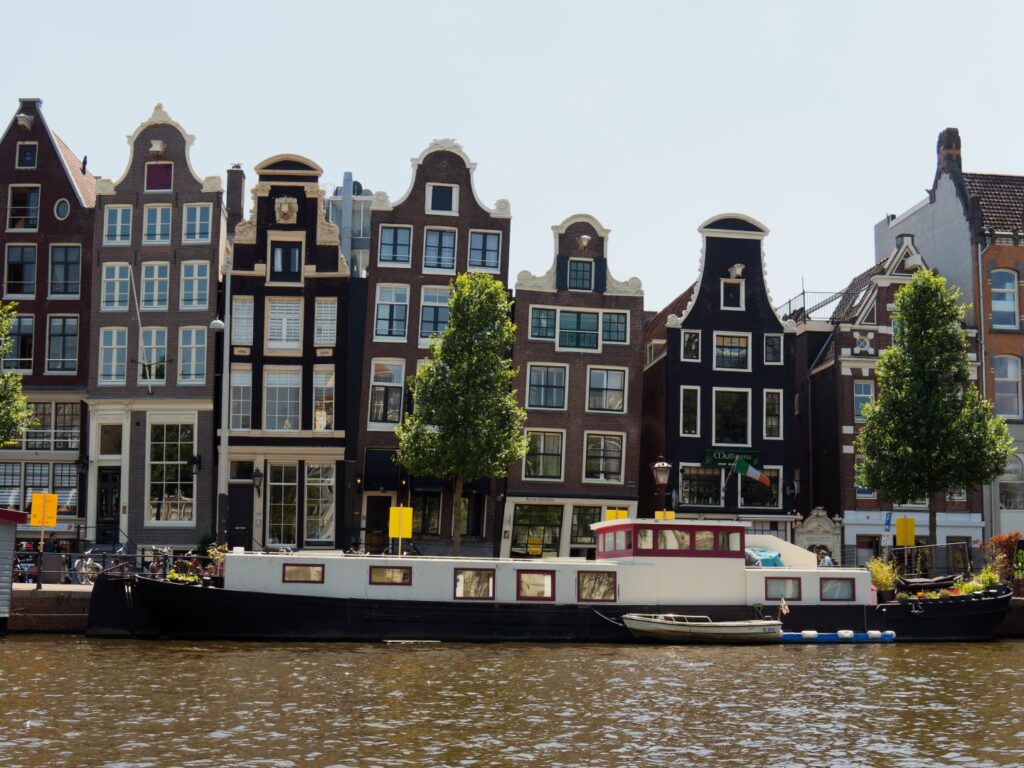
Amsterdam’s historic core is certainly interesting but may be a bit much for my injured brain. But even for us, we would visit again to see some specific things we were unable to visit on this trip.
Toilets
The Netherlands, and I understand much of Europe, doesn’t really have public toilets like we do in the U.S. If there is a public toilet, it is likely a pay toilet, 75 cents to 1 Euro to use.
Toilets are usually free to paying customers at a restaurant, or an attraction, such as a museum – in other words, places where you pay admission fees.
We didn’t find it to be a big problem but it’s different.
“Safety Culture”
Here in the U.S., we have what we call a “safety culture”. We have warnings on everything, and constantly caution people about every possible thing that could go wrong.
If you go on a boat ride in the U.S., you are sure to be told where the life preservers are and given a brief talk on emergency procedures. In the Netherlands, there is none of that. Another example: the U.S. would require fencing along all the canals! We wouldn’t want someone to fall in!
In a similar way, the bicycling system is a bit crazy. I used to ride a bike everywhere myself, so bicycling is not foreign to me. In the Netherlands, bicycles have priority over cars and pedestrians. Takes a while to get this idea in our heads – we absolutely have to look in all directions and judge the speed of oncoming cyclists before crossing. The bicycles have the right of way over pedestrians and getting in their way will lead to at least a nasty look.
In Utrecht, in the late afternoon as people headed home, there might be hundreds of cyclists going in both directions on a bike lane and swerving and weaving into intersecting bike lanes. Trying to cross these, as a pedestrian, is really hard (and scary) as you may have to look 4 different ways and try to find a brief break to run across. We saw one minor, low speed crash among two tweens – with one falling to the ground. He seemed to think it was pretty funny 🙂
We saw cyclists get ornery at some pedestrians who dared crossed a busy bike lane.
To add to the craziness, people on motorcycles, scooters and electric scooters often ride in the same bike lanes. The electric scooters are quiet, and they can come flying out of nowhere at 25 mph – you never even hear them.
Cycling makes a ton of sense in the Netherlands due to narrow roads and lanes, not enough room for cars, lots of people, density and the flat terrain. If I lived there, I would certainly embrace cycling as the best way to get around locally.
There seem to be more smokers than what we are used to.
Languages
- interesting to be somewhere where most everything is in a different language. There is overlap with English and Norwegian which helps (me) for reading, but not listening to spoken Dutch.
- Felt awkward to be a dumb American who only speaks one language. Good news is that I could read more Dutch than I expected, based on my knowledge of English and Norwegian – Dutch has a fair overlap with both of those languages. With contextual clues, I could figure out many things. Of course, most everyone in the Netherlands also speaks English and it’s rare to encounter someone who does not know at least some English.
- I had planned to spend a month reviewing basic Dutch to get some familiarity with the language but that fell apart when I got hepatitis, an emergency tooth extraction, a routine colonoscopy – all in the weeks before the trip when I was going to give myself an introduction to Dutch.
- As I discovered the past year, there are great reasons to learn at least one additional language. Unfortunately, in the U.S., few students will study another language, and those that do, will do so merely because it is required for admission to some college programs.
Planning
Our trip planning really paid off – very glad I put so much effort into the planning. I have a separate post describing my planning process.
My planning went beyond just figuring out things to do. Well before we left, I experimented with different hiking shoes and luggage options to figure out what would work best. I bought new convertible pants – converts from long pants to shorts. I experimented with washing clothes in a hotel sink – makes it possible to reuse some shirts without having to do a full laundry stop.
Cameras
I took my Olympus E-M1 mk ii, a 5-year-old camera body I bought used. I took my 14-140, 12-60, 9-18mm lenses, plus a 14 and 20 mm prime. The lens I used the most was the 12-60, then the 14mm, then the 9-18mm wide angle. I barely used the 14-140 and never used the 20mm.
I also carried my old Lumix 3D1 3D camera and took about 125 3D photos.
Update: After several trips – mostly domestic, via car and one via airline – I am rethinking my lens choices. Am thinking of taking as little as one or two lenses, maybe the 12-60 or the 14-140 and the 14mm pancake. I want to travel as light as I can. The 12-60 is my only lens that is “water resistant”, which is nice if out in the rain but other than that, I might do without it and reduce the weight.