
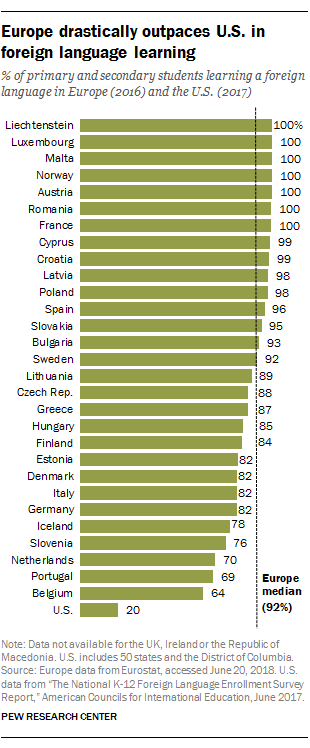
- 91% of European school kids take English classes starting between age 6-8.
- In 20 EU countries, students are required to study a 3rd language (other than their own or English) starting between age 8-10.
- By comparison, in the U.S., some students will, typically, take 2 years of a foreign language starting at about age 15 or 16. And this is primarily because many colleges and universities require applicants to have two years of a foreign language – not because learning a foreign language might be beneficial.
- Researchers think the ideal time to learn another language is no later than age 10, and that it is rarely possible to achieve “fluency” status if started after age 17. So of course, in the U.S. the students who do study a foreign language start at around age 17 …
- Europeans, as a general rule, have a far more international or global perspective than people in the U.S.
- Only about 20% of U.S. students will study a foreign language (with a majority taking Spanish) as shown in this chart from Pew Research. The full report from the American Councils for International Education, was sponsored by the Defense Language and National Security Education Office, with other well-known organizations.
- About 60% of the world’s population has some ability in 2 or more languages
- About 43% of the world’s population is fluent (high skill) in 2 or more languages
- About 13% of the world’s population is fluent in English and another 12% have some English language ability.
- When you learn another language, you learn more than speaking in that language – you also learn about the culture, geography and history of those communities. You develop respect for their practices. You may find that other languages have different words and ways of thinking about issues. Learning another language opens your mind. I am currently studying Norwegian, and this has been a huge mind expansion, including learning more about English and its history than I ever knew (English and Norwegian are both derivatives of Old Norse, which was a pre-cursor of many European languages including German, Dutch, English). I am also reviewing Spanish but have a lot of work ahead of me to improve my Spanish skills.
- Read the comments to this NY Times article on the lack of foreign language education in the United States. An eye opener.
- The lack of interest in learning other languages, in the U.S., is a sign of disrespect of other cultures. We believe we are so important we do not need to interact with others.
I repeat the old joke:
- What do you call someone who speaks more than 2 languages? A polyglot.
- What do you call someone who speaks 2 languages? Bilingual.
- What do you call someone who speaks one language? An American.
Random and Surprising Items
- Until 2017, UK Prime Minister Boris Johnson had dual UK and U.S. citizenship. In fact, he was born in New York City and was a citizen of the United States! He renounced his U.S. citizenship in 2017 (for tax reasons).
- Barack Obama was born in Hawaii and has been a U.S. citizen since birth. However, since his father was a Kenyan economist, Kenya automatically made him a “right of descent” dual citizen of Kenya. When he reached about age 25, he would have then had to apply to Kenya to retain that right of descent citizenship, but he did not do so. He also held Indonesian citizenship as a child. After his parents split, he lived with his Mom, an anthropology professor, in Indonesia for several years before returning to live in the U.S. with his Mom’s parents.
- The United States is one of only two countries in the world that taxes all global income of its citizens. Most countries only tax income earned within the country, not income earned in other countries. This results in double taxation for many Americans living abroad. Several countries have tax treaties that enable taxes paid in a foreign country (where one is living abroad) to be deducted from American taxes owed. However, this generally applies only to “earned income” (such as from wages) and does not apply to capital gain income. If you sell an asset, you then are taxed twice on the capital gain – once in the country where you are living and again in the United States.
- The U.S. has a steep “Exit” tax on Americans who move abroad, become a citizen of another country, and then renounce their U.S. citizenship. Those who renounce their citizenship are required to pay 30% of their assets to the U.S. Treasury. A side effect of this is that for older Americans, who are most likely to have accumulated assets (savings, home ownership, investments) are de facto unlikely to leave the U.S. permanently and become a citizen elsewhere due to the high costs involved. Thus, like many travel issues, the U.S. government has de facto age discrimination policies. Americans may renounce citizenship for many reasons. Some were Americans by accident – literally born to foreign parents on U.S. territory but basically never lived in the U.S. Others married a citizen of another country, moved permanently to that country and are no longer connected to the U.S. These individuals also seek to avoid the U.S. global double taxation policies.
Afterward
I have always been supportive of public schools, have spent over a decade as a volunteer in various skill areas, and thought our own kids had decent educations. My oldest daughter mentioned something I’d not realized: Less than 1 in 4 graduating seniors from her high school went on to college. Whoa! That is abysmal and compares to about 41% for the national average.
Compare (from the US Census)
- Almost half (47.4%) of the foreign-born population who arrived in the United States over the past decade had a college degree — a higher rate than both earlier foreign-born and native-born Americans.
- An estimated 47.4% of the foreign-born population who arrived in the United States from 2010 to 2019 had a bachelor’s degree or higher, compared to 36.3% of native-born Americans and 31.5% of the foreign-born population who entered the country in or before 2009.
- In 2019, 39.4% of naturalized citizens and 40.2% of children of the foreign-born population in the United States had a bachelor’s degree or higher, compared to 35.9% of those born to native-born parents. A greater share of the foreign-born population (14.1%) than native-born Americans (13.4%) also held an advanced degree, such as a master’s or doctorate.
- From 2010 to 2019, the percentage of people age 25 and older with a bachelor’s degree or higher jumped from 29.9% to 36.0%.
The high percentage of college educated immigrants is, in part, because our immigration policies favor those with college degrees and disfavor granting visas to those without degrees.
However, consider that this means a typical immigrant professional worker is well educated, speaks more than one language, and has broader international skills.
Seeing this, should politicians be concerned about Americans global skills deficits?
2 thoughts on “U.S. ranks extremely poorly in foreign language instruction in public schools”
Comments are closed.