
A weekly staple of “Travel” and “Lifestyle” news is the “I moved abroad” genre.
The stories follow a formula:
- This individual or family suffered a hardship in the U.S. (divorce, crime, health care or housing costs too much, politics are ugly, they do not like the U.S. work culture, etc.)
- So they packed up and moved to Europe.
- Where everything is wonderful and they live happily every after.
- About 40% of the stories are wrapped within a romance.
That’s based on a 2+ year collection of 400 stories in the media.
Reality, however, is vastly different than the media stories.
Bias #1: 80% of Stories Involve Americans Moving to Europe
In reality, 20-24% of Americans who move abroad, live in Europe. Most Americans who move abroad live in Mexico or Canada.
The large blue column, at left, is the % of media stories regarding moves to Europe/UK/Ireland. Media coverage GREATLY EXCEEDS the actual number (Orange, Green and light Blue columns).
As you look to the right in the chart, you see that media stories largely ignore Americans living in Mexico, Canada and other regions of the world. Why this bias occurs is explained, below.

| Region | Media Stories | Estimate 1 | Estimate 2 | Estimate 3 |
| Europe/UK/Irelandd | 80.05% | 20.00% | 24% | 23% |
| Mexico | 2.85% | 26.00% | 15% | 22% |
| Canada | 2.07% | 13.00% | 24% | 19% |
| S & C America | 5.18% | 7.00% | 10% | 11% |
| Asia | 5.96% | 10.00% | 11% | 13% |
| Africa/Mideast | 1.81% | 4.00% | 3% | 8% |
| Aus/NZ | 2.07% | 2.00% | 4% | 4% |
The data table uses three estimates for the percent of Americans living in each geographical region. The percentages vary due to variations in how the estimates are made.
Second, some of the estimates include Americans temporarily living in Mexico or other countries on six-month tourist visas – but who do not have residency or dual citizenship.
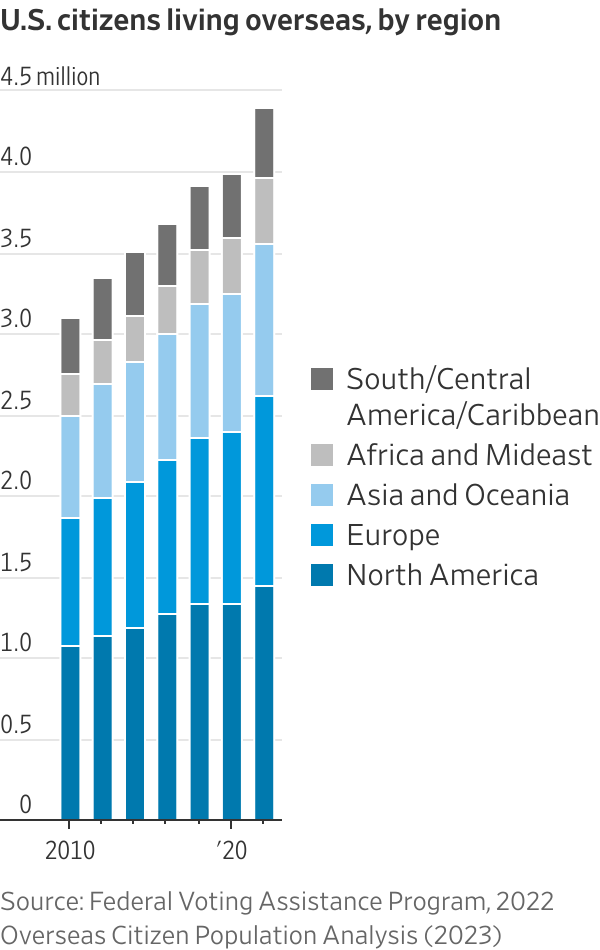
Here is another data chart – the European column section is about 20% of the total.
Bias #2: Most Americans Moving Abroad Have an Immigration Privilege
- 40% of those who moved abroad obtained their residency visa via marriage to a foreigner. 90% of this category are highly educated, young, American women who married a foreigner. These stories are targeted at women – and combining a move abroad with a dreamy romance story makes for great click-bait.
- 16% were already dual citizens of the US and the other country, often because they were born in the US to immigrant parents, giving them a right of citizenship in the US and their parents country. (Most countries in the Americas grant citizenship based on where you were born whereas most of the rest of the world grants citizenship on the basis of your parent’s citizenship status)
- 8% had a right of descent ancestry. Several countries including Ireland, Italy, Poland and others offer citizenship based on your ancestry which may include that you had grandparents who had been citizens of one of those countries.
Those 3 groups, combined, account for 64% of all story subjects. They had had a unique immigration privilege that most of us lack.

Bias #3 – Who Writes These Stories
These “I moved abroad” stories are written, mostly, by young, white, female, freelance writers, many of whom are writing about their own experience.
Studies find that many (if not most) of these writers come from privileged backgrounds in the U.S., having attended private universities and done one or more study abroad programs. Per the studies, their wealth permitted them to pursue “passion” degrees (such as creative writing or English Literature) to study at expensive private universities ($80k to $100/year in unsubsidized prices, often earning a Masters in journalism at a “name” school, costing up to an additional $100k), to complete a degree or degrees in fields the US Bureau of Labor Statistic says average US$52,000 per year in earnings (which makes little sense from an ROI perspective – but these writers do it because they have the parents’ financial resources to not pick a career focused on earnings.)
The writers’ backgrounds introduce another bias to the stories – that of wealth and privilege.
Most of the writers are of European ancestry, had traveled to Europe earlier in life and did study abroad programs, typically in Europe – and write about what they know – which is their own life.
More on those who write these stories and the bias this creates: Why Europe Dominates “I Moved Abroad” Stories – Coldstreams Travel and Global Thinking
The Effect
The Effect is “I moved abroad” stories are overwhelmingly biased to
- Privileged Americans, who came from sufficiently wealthy backgrounds to do study abroad and other international travels
- Did a study abroad in Europe
- They write about their own experiences – which is European centric
- They came from privilege backgrounds enabling study at private universities, and doing study abroad programs
- The stories come from a community of freelance writers who are overwhelmingly young, and female
- 40% involve an American woman who married a foreigner and moved abroad
Moves to elsewhere in the world are barely a blip in this genre of stories.