That means more than 1 out of every 6 people in the U.S. was an immigrant – that counts both legal and illegal immigration. This group also made up 1 in 5 workers in the United States.
Also, the distribution of immigrants in the U.S. is not equal – more than 1 in 5 residents of the western U.S. are foreign born.
Also, as of 2025, 42% of Americans were either foreign born or have at least one parent who is foreign born. Wow!
The foreign-born population is not distributed equally across the country:
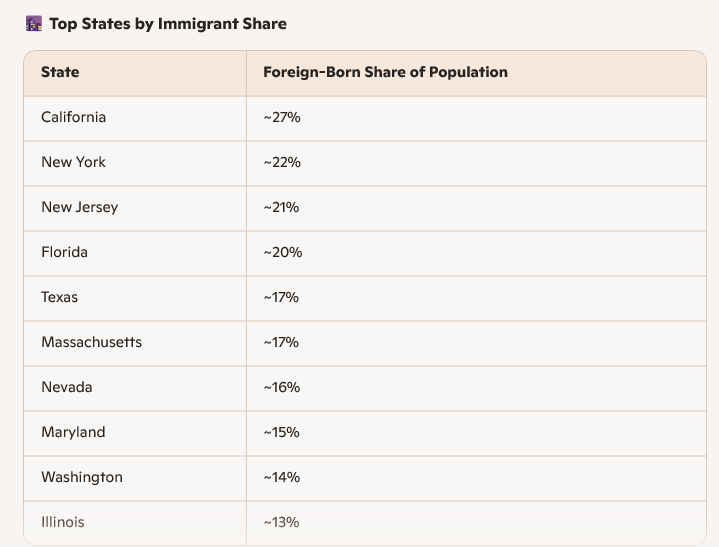
In several of the states, the percent who are foreign born or who have at least one parent who is foreign born exceeds 50-60% of all residents.
This means several things:
- The % of Americans with close immigrant connections is huge. I had previously estimated this at up to 60% nationwide, particularly if we include those with at least one parent or grandparent who is an immigrant.
- Many of these immigrants likely have a right of descent ancestry privilege in other countries. Estimates range from 25-40+% of Americans may have an ancestry immigration privilege entitling them to dual citizenship in another country. Which is staggering.
Heritage Americans
I have an upcoming post on “heritage Americans” which is term used to describe persons who trace much or most of their ancestry back to the founding of the U.S. – predominantly white, English/Scottish, and Protestant backgrounds. This group today makes up 15-25% of the population and is gradually shrinking due to low fertility rates and high inbound immigration rate into the U.S. “heritage Americans” are either a minority group or soon will be.
The terminology “heritage Americans” comes with controversy because some who have used the term imply that they, a heritage American, are “more American” than others, particularly immigrants.
I can trace my ancestry in the U.S. back to the early 1600s (one of my ancestors was a key player in the founding of Harvard College); all of my ancestors were either from way back then, or from another group arriving from Norway, and Switzerland and areas of what today would be Germany, in the mid 1800s. While that makes me a “heritage American” I do not agree it makes me “more American” than others. It does, however, mean I have no right of descent ancestry in other countries as those of recent immigration do – thus there are differences in these groups.