First, we are in a globalized world. As explained elsewhere on this blog, an estimated 75% of the U.S. population has visited at least one other country, and 26% have been to 5+ countries. More than 15% of adults were born abroad (Immigration: U.S. Immigrant Population Reaches Highest Since 1890 – Coldstreams Travel and Global Thinking), 20% are either an immigrant or the child of immigrants (1 out of 5 U.S. residents were born abroad or their parents were born abroad – Coldstreams Travel and Global Thinking), and 40% have one or more grandparents who were born abroad. The effect is that perhaps 2 out of 3 American residents has close immigrant ties!
Even if you are not an immigrant, you will likely work side by side with immigrants, manage immigrant workers, or to be managed by an immigrant – or work in a business whose products and services are international in scope. Consequently, global experience is essential to move ahead and work in a leadership position in your career.
(Also see International: How Global Are We? A Summary – Coldstreams Travel and Global Thinking)
Second, it is usually easier for young to travel abroad (except for financial and career issues).
- Many do not own a home; while traveling they won’t have home or rent expenses to keep up
- Many do not yet have families and family expenses; having a family makes travel more expensive
- Health insurance for travel abroad is much less expensive when young than when you are 65+ years old – the difference can be 3x to 5x more expensive when older. In some cases, you may not be able to get travel insurance for pre-existing health conditions, which are more common when old.
- Your health and physical abilities and stamina are likely to be stronger when young. Until 2020 (and the pandemic nonsense) I was a jogger and went to a gym 3 days per week. Unfortunately, I broke my right foot and lived in a state that during Covid, restricted health care access to life threatening emergencies – for months. That untreated fracture, plus another in late 2023, set me way back – when we are older, our bodies do not heal as fast. These led to a cascade of injury effects that I am only recovering from years later, at the end of 2025.
- When young, you can and will eat a lot more than when you are older. Part of travel is enjoying the foods of other cultures. But when older, you’ll find you eat less.
- If you wish to work abroad or spend time living in another country, this is much easier to do when younger. Depending on the country, restrictions on residency visas may begin at the age 35-55 bracket. In some countries, a residency visas is prohibited for those as young as age 50 or 55, or there are other restrictions (France prohibits mortgages to those at age 55 or over). Also, when younger than 30 or 35, several companies offer “Working Holiday Visas” that are easy to get and enable you to stay and work in a country for 1-3 years. But these are not available as you get older.
- Many options go away, or become more difficult or more expensive as you get older.
- Finally, being globally experienced can be important in career opportunities (depending on your field). It is more valuable to obtain these skills when young so you can apply them in your career, sooner, rather than late in your career.
Another consideration is how to maintain job skills and employability for when you end your travels. In some fields, such as computer science, the pace of change is rapid, and leaving the field for as little as 6 to 12 months might require you get additional training upon your return, in order to get back up to speed and get a good job again. In other fields, this may not be an issue -and for some, international experience will be a plus on the resume. Ideally, taking a work assignment abroad can enable you to get global experience and maintain your job skills.
Today’s younger generations, in spite of doomerism news stories, have things better than the past regarding employment. At the tail end of the baby boom, the typical family had 4 kids. Today, families have, on average, less than 2 kids. You can see this in the chart of the U.S. fertility rate over time. The “baby boom” could not take gap years, year long leave of absence, etc to go travel – there were 200 other people waiting to take your job.
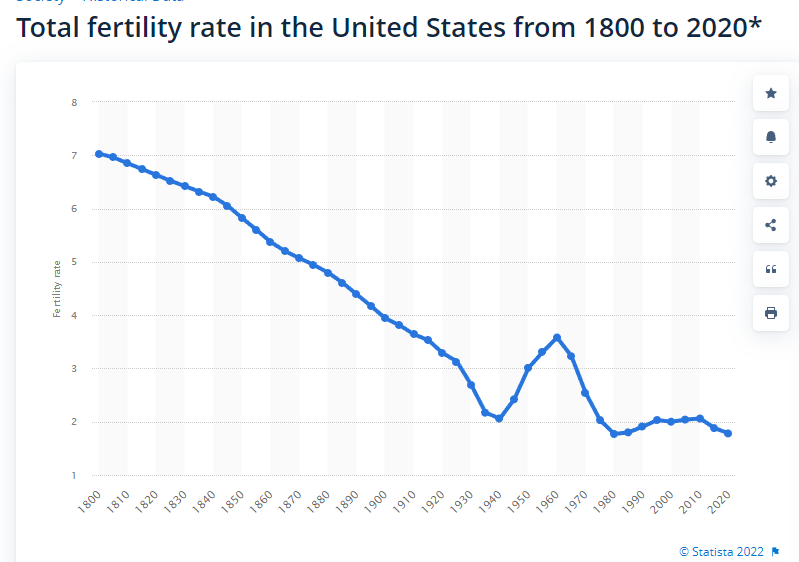
Persons born about 1960 were competing with more young people for jobs than any cohort in over 100 years (or more, as deaths under age 5, due to childhood disease, were high before the modern era).
This is why the tail end of the baby boom embraced college – versus their predecessor generations – to increase their skills and out compete everyone else seeking jobs. Up until about 1965, half of all adults living in the U.S. had not graduated from high school!
The generations following had far less competition, as seen in the fertility rate chart, above.
What this means – fast forward to the right end of the above chart. Today’s young job entrants are competing with fewer new workers for jobs, hence, unemployment of 3.7% (versus an average unemployment level of 6+% from the 1970s onward – see historical unemployment, below. This means, young people can now consider taking time out from work to travel – and develop global skills.
Unemployment rate since 1946 to the present, at far right. Unemployment hit over 10% in the early 1980s, and for almost 20 years, was frequently above 7.5%, as the “baby boom” cohort hit the job market. Excluding the Covid pandemic (and some very dumb government policies), unemployment has trended lower.

This post was inspired by this story – and the vast differences between 40-60 years ago, and today. My generation did not have this opportunity.
So I quit my job at 32, bought a one-way ticket to Peru, and spent a year and a half — and $34,000 — exploring 18 countries across South America and Asia. Every day was a “choose your own adventure,” involving choices good and bad. I learned lessons the hard way about balancing preparation, productivity and play.
I quit my dream job at 32 and spent $34,000 to travel the world—here are my 4 biggest regrets
The above is why I support the notion that today’s young people, to the extent they can do so, should engage in international experiences including study abroad, work abroad or travel.