Category Archives: Gear

Using the Minolta 58mm f/1.4 lens on a Nikon 1 J1 camera

I like experimenting and using “non-standard” camera configurations. In a world of full frame DSLRs, I tend to use little sensors because its more challenging. Or something!

Here, I shot a couple of test shots (JPEG mode, not RAW) using a Minolta f/1.4 58mm prime lens. Both photos were taken using an MD mount to Nikon 1 mount adapter on the Nikon 1 J1 (10 megapixel) camera with a 1″ sensor. Both photos are shot with the aperture set to f/2.0; at f/1.4 the lens is very soft, typical of most older lenses when used wide open. For a portrait shot where soft focus may be desired, f/1.4 is okay, but for other shots the softness is distracting. At f/2.0 and smaller apertures (f2.8, f4 especially) the lens gets really sharp.

Each of these photos was resized to 1/2 the original for uploading to my blog site.

resized0001

resized0002

Gear Acquisition Syndrome – always needing the next best camera or lens

Fascinating first hand story:

I used to be a real photography gear head, I bought and sold cameras right and left, I was left broke and miserable, here’s what you can learn from my ordeal

Source: Confessions of an ex-gear addict

When I stopped at a beach overlook recently, I was surprised at how many very expensive cameras and lenses I saw being carried along the trails. Then I saw a photo, shared on Facebook, of a crowd of people in Yosemite, with very expensive cameras, sometimes several of them, all taking the exact same photo of the annual Horsetail Falls orange-lit “fire fall”. The last time I was in Zion National Park, I saw a long line of tripods and expensive cameras and long lenses set up to take the same photo of the sunset. Same thing in Yellowstone – and worse, where individuals were carrying professional video gear, including RED cameras.

What struck me was just how much money so many people have (or had!) that they can afford to spend tens of thousands of $s on cameras and lenses. Sure, some are professional photographers, some are semi-pro (a hobby that sometimes makes money), then serious amateurs and then those who just buy really expensive gear.

The linked article is well worth reading – its a self confession by one photographer who suffered badly from Gear Acquisition Syndrome, buying and selling one or more cameras, lights, reflectors, after another, after another.

The greatest fear for camera makers is that at some point, a whole lot of people decide to downsize their camera and lens arsenal!

The Lumix 45-200mm lens is not so sharp – at the long end

A week ago, I shot several photos using a Lumix GH-4 and the Lumix 45-200mm lens, and then shot the same photos using a Nikon 1 J1 with the 1 Nikkor 30-110mm lens. Much to my surprise, the Nikon 1 photos were consistently sharper and better looking! That’s a surprise because the Nikon 1 has a 10.1 megapixel Super16mm film sized sensor while the Lumix GH-4 is 14-16 megapixels on a 4/3ds sensor!

I did some testing and the Lumix 45-200mm lens is not so sharp at the long end (but see the update below!). When I replaced that lens with the Lumix 20mm f/1.7  – or even an ancient Vivitar 135mm Minolta MD/MC mount lens – I obtained sharper results in my test photos. I also found my old Sigma 28-70mm Minolta mount lens, and the Minolta 50mm f/1.4 lens (at f/4) were sharper.

The Lumix 45-200mm is  inexpensive and its optical image stabilization is quite good. The GH-4 has a far better auto focus mechanism than did the GH-2 and does a great job of auto focus with the 45-200mm lens.

Update: Early version of the lens firmware had a soft focus problem at the long end; this was fixed with a subsequent firmware upgrade. I also observed, now, that the lens is sharp, but just not as much at the 200mm end. Based on comments from others, good suggestions are to:

  • Avoid using the full 200mm, unless you have to. Backing off to 150-175mm significantly improves sharpness.
  • Use a tripod. The 200mm image stabilized lens is equivalent to a 400mm full frame lens. That’s a lot of magnification for a handheld shot.
  • Possibly use manual focus to avoid any auto focus issues.

Here’s a photo I took at the shorter end of the lens, using a Lumix GH-4. If you click through the image to Flickr, you can see the full size image – and the sharpness is excellent. It seems the best step to take is, if possible, back off a bit from the 200mm end to improve sharpness.

A clear winter day at Lake Union, Seattle, Washington


The next photo was taken at 200 mm and the sharpness is decent, albeit softer than the above. I did have to increase contrast and add image sharpening in Lightroom for this photo, but that had more to do with the conditions at the time the shot was made.
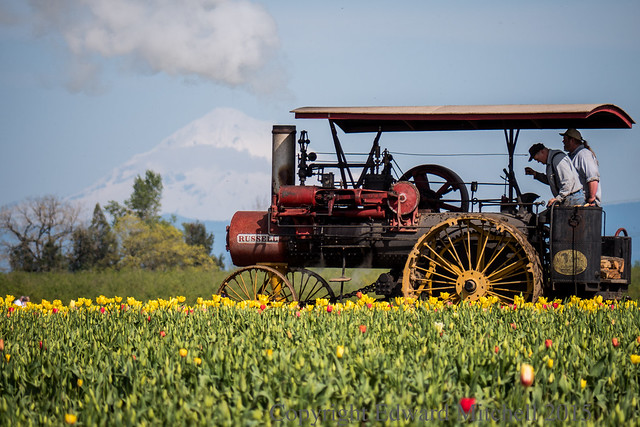
Wooden Shoe Tulip  Festival

I have other photos were the sharpness is less than the above – and I think it may be due to either a handheld shot or that the auto focus was not nailing the focus perfectly.

The Nikon 1 cameras and the 1 Nikkor lenses are amazingly sharp with excellent contrast. Like most camera and lens combinations, it is up to us to figure out the characteristics of the pair and learn to optimize those for best results.